Description
Description
Z Natural Foods is committed to offering our customers a diverse selection of high-quality foods in their most versatile forms.
Our Organic Holy Basil (Tulsi) Powder is a prime example of our commitment to quality.
Today, I aim to answer some of the most frequently asked questions about this versatile herb, known as the queen of herbs, to ensure you have all the information you need to make informed choices about your plant medicines.
1) What are some interesting and unique facts about Holy Basil leaf?
- Holy basil is a member of the mint family.
- Holy basil has a complex flavor profile, being sweet, spicy, and astringent, with undertones of clove, mint, anise, and lemon.
- There are over 150 varieties of basil, each with its own unique flavor profile.
- Because holy basil is high in eugenol, nerol, and camphor, it is an effective natural insect repellent and is avoided by deer and rabbits.
- Chewing holy basil leaves may help reduce bacteria in your mouth and give you fresher breath.
- While holy basil has many medicinal properties, two of its lesser-known uses are as a galactagogue (increases breast milk) and an antipyretic (fever reducer).
- Holy basil is called holy because it is considered sacred in Hinduism, where it is revered as a divine being.
- There are three main types of holy basil: rama/sweet, krishna/peppery, and vana/citrusy.
2) What is Ayurveda’s perspective of Tulsi, and how is it primarily used in this form of medicine?
It is well known that holy basil leaf (Tulsi) is a primary tonic herb in Ayurvedic medicine.
However, to answer this question in context, it is vital to understand the basic principles of Ayurvedic Medicine.
Ayurvedic medicine works on three primary doshas (Vata, Pitta, and Kapha), which comprise the elements (water, earth, air, fire, and ether). Doshas are believed to be the energies that circulate in the body and govern physiological activity.
- Vata is the movement of blood, oxygen, and neurotransmitters. It governs the movement of thoughts, emotions, and bodily functions.
- Pitta comprises fire and water elements. It governs metabolism, transforming food into energy. Pitta is the fire that governs physical digestion and the mental digestion of life experiences.
- Kapha: The structure of grounding and stability governing nourishment and growth. It governs stability, strength, and lubrication in the body. It is important to note that excess Kapha can lead to lethargy, weight gain, and congestion.
Furthermore, one of the unique principles of Ayurveda is the understanding of health as a result of the coordinated functioning of the soul, mind, and body in an intimate relationship with everything else in the cosmos- material and non material. It believes the constituent factors of the human body and the cosmos are the same.
Finally, Ayurvedic medicine often evaluates foods and herbs based on their energetic qualities, using a framework called Dravya Guna to analyze how a substance (food or herb) interacts with the body and mind from the moment it is tasted through its final metabolic stages.
Therefore, practitioners describe Holy Basil’s Ayurvedic energetic and dosha profile as follows.
- Rasa (Taste): The immediate sensation on the tongue; Mostly pungent and bitter.
- Guna (Qualities): The inherent physical properties (how it feels in the tissues): Light, dry, and sharp
- Virya (Potency): The herb's thermal effect once ingested; Hot, warming
- Vipaka (Post-digestive effect): The long-term impact once digestion is complete; Pungent
Finally, while there are 150 varieties of basil, Ayurveda traditionally uses three types:
- Rama: Green leaf variety and sweet
- Krishna: Dark green to purple, considered more potent with a bright peppery flavor profile.
- Vana: A wild variety with a lemony/citrusy flavor profile.
3) How is Holy Basil used in Traditional Chinese Medicine?
While not considered one of the traditional tonics in TCM, such as Ginseng, Goji, and He Sho Wu, Holy Basil is recognized by modern practitioners as a significant Shen tonic with adaptogenic-like qualities.
According to Traditional Chinese Medicine (TCM), Ji Xue Cao, aka Holy Basil, is:
- Warm in nature with a bitter, pungent, sweet flavor and astringent properties.
- Part of a category of herbs known for clearing damp-heat and damp-phlegm, and considered a warming herb for and not cooling for pure excess heat.
- Has an affinity for the spleen, kidney, and the heart channels, specifically as a superior shen tonic that lifts the spirit and calms anxiety.
Furthermore, one of the primary theories of TCM is the five phases. It states that the ingredient's taste is a key to determining its action in the body.
- Pungent, warming ingredients often promote the circulation of Qi and body fluids. Bitter, pungent, and warming herbs such as Holy Basil often have clearing and drying actions that promote elimination through the urine and bowels, particularly in damp, cold conditions. Therefore, holy basil is a great Yang tonifier.
- The five-phase theory also connects taste with the organs and meridians it targets. Holy Basil is believed to target the spleen (assists in digestion and fluid metabolism), the kidneys (regulates urinary and reproductive functions and stores Jing, the life essence), and the heart (regulates blood and blood vessels, and all mental activities, also known as shen).
4) What is Western Herbalism’s perspective on Holy Basil?
Western herbalism considers Holy Basil a powerful nervine and nootropic with adaptogenic-like qualities that may help with the following:
- Lifting the spirit
- Increasing clarity of thought
- Reducing mental fog associated with menopause and chronic stress
- Potentially dispels depression
However, in Western herbal medicine, holy basil is defined as a nootropic herb.
Nootropics are a category of substances (both natural and synthetic) that show potential to improve cognitive function by promoting relaxation and supporting mood, memory, attention, and creativity. The Romanian psychologist Corneliu Giurgea first defined the term "nootropic" and was also the first to synthesize one of the best-known substances in this category, Piracetam, in 1964. The Giurgea Nootropic Criteria state that for any substance to be considered a nootropic, it must do the following:
- Enhance learning and memory.
- Enhance the resistance of learned behaviors/memories to conditions that disrupt them.
- Protect the brain against a broad spectrum of physical or chemical injuries.
- Increase our ability to focus and pay attention
- Lack of common side effects that are related to other psychotropic drugs
- Be non-toxic at clinical dosages
Finally, in traditional medicine, nootropics are not typically used as standalone agents. They are usually combined with supportive herbs, such as adaptogens and nervines, to balance their effects.
5) Is Holy Basil a “true” adaptogen?
To answer this question, it is essential to review the criteria that define an adaptogen. For an herb to be considered an adaptogen, it must meet the following criteria:
- Be nontoxic at clinical dosage.
- Increase the resistance of the hormonal and immune systems to various stressors through a nonspecific physiological response.
- Normalize body function regardless of how external stressors have altered it.
However, as research has progressed, we have learned that the primary factor distinguishing plants and fungi as adaptogens is their ability to act through one or both of the body’s master control systems.
- The HPA Axis (Hypothalamic-Pituitary-Adrenal Axis) is a complex system of neuroendocrine pathways and feedback loops that maintains and supports homeostasis in response to chronic stress. The HPA axis interfaces the endocrine, nervous, immune, digestive, reproductive, and cardiovascular systems.
- The SAS (Sympatho Adrenal system, aka fight or flight) is a complex system that connects the sympathetic nervous system to the adrenal medulla. In simple terms, it is our fight-or-flight response. A triggered response floods our system with adrenaline and releases hormones epinephrine and norepinephrine from the adrenal medulla. This response increases blood pressure, blood sugar, and heart rate and suppresses digestion. This releasing of hormones and the redistribution of blood allow the mind and body to respond and survive.
Therefore, in simple terms, Holy basil is NOT an actual adaptogen.
Instead, it is a Nootropic with adaptogen-like and anxiolytic qualities.
6) What are some of Holy Basil’s herbal allies?
Before I answer this question, it is vital to define what herbal allies are.
In simple terms, herbal allies are plant medicines that work well together, creating a more potent effect through synergy and by supporting each other's primary mechanisms of action. Understanding this concept is how some of the most traditional and effective formulas have been created.
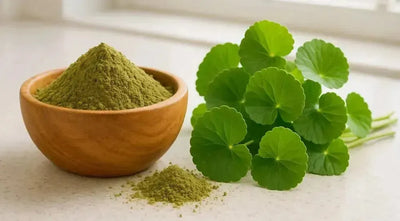
One of holy basil’s great herbal allies is Gotu Kola. Much like holy basil, gotu kola has a long-standing tradition in TCM and Western herbalism. However, these are most traditionally combined in Ayurveda.
In Ayurvedic medicine, gotu kola is known as a “pharmacy in one herb” because of its wide range of potential benefits:
- Brain tonic (supports blood flow to the brain, feet, and hands)
- Skin condition disorders (red, inflamed skin),
- Antioxidant, diuretic, systemic anti-inflammatory, and anti-bacterial
Gotu kola is widely used as a rasayana (tonic), with an average daily dose of 3-6 grams, to support strength, skin quality, digestive function, and improve intelligence. Yogis traditionally use Gotu kola to develop the crown chakra. A cup of gotu kola tea before meditation is believed to heighten awareness and calm the mind and emotions.
Ayurvedic qualities of Gotu Kola
- Rasa (Taste): Bitter
- Guna (Qualities): Light to digest
- Vipaka (Third level of digesting, deep level of taste), Sweet taste after digestion
- Veerya (Potency): Cold
- Effects on Tridosha (The influence of movement, transformation, and sensory functions): Balances kapha and pitta due to bitterness
- Pravhaba (effect of the herb): Improves intelligence
The synergy of these potent herbs complements their mechanisms to:
- Manage stress: While neither of these herbs is an actual adaptogen, holy basil's adaptogen-like qualities provide an immediate calming effect by balancing stress hormones, while gotu kola’s slower-acting, long-term support of the nervous system makes this a match made in heaven.
- Supports higher cognitive function: Gotu Kola improves circulation to the brain, supports neuronal health, and enhances memory. Holy Basil assists memory and mental clarity by supporting a healthy stress response. Furthermore, acts as an acetylcholinesterase inhibitor, preserving acetylcholine, a neurotransmitter vital for learning and memory. Compounds found in holy basil, like linalool, calm the central nervous system, while eugenol can stimulate alertness. Together, these two herbs support clear, healthy thinking.
- Provide systemic balance in the nervous system: Both herbs function as classic nervines and nootropics without sedative effects.
Both of these potent herbs may support a healthy inflammation response through the following mechanisms of action.
Holy basil
- Inhibiting enzymes like cyclooxygenase (COX) and lipoxygenase (LOX) that create inflammatory substances (prostaglandins and leukotrienes).
- Reducing the activation of Nuclear Factor kappa-light-chain-enhancer of activated B cells (NF-κB), a key protein complex that turns on genes for pro-inflammatory cytokines.
- Decreasing the production of inflammatory messengers like Tumor Necrosis Factor-alpha (TNF-α) and Interleukin-6 (IL-6).
Gotu Kola
- Blocking inducible nitric oxide synthase (iNOS) and COX-2 and reducing nitric oxide and prostaglandin production, which are key drivers of inflammation and swelling.
- Decreasing the production of inflammatory cytokines like TNF-alpha and IL-6, and lessening the body's inflammatory response.
- Increasing collagen and fibronectin synthesis, strengthening skin and connective tissues, while its antioxidant properties neutralize free radicals that trigger inflammation.
- Increases mucus production (mucin) and glycoproteins, fortifying the stomach lining against damage and inflammation, as seen in ulcer models.
- Prevents excessive accumulation of inflammatory cells in tissues, which is crucial in conditions such as arthritis and helps reduce joint destruction.
In conclusion, here at Z Natural Foods, we believe that the whole is greater than the sum of its parts. Understanding the synergy of polyphenolic compounds versus their effects as isolated compounds in potent herbs is the cornerstone of future research on the power of herbal medicine.
Ultimately, holy basil and other herbs in their respective categories are tremendous tonics with proven efficacy, and with further research, they show promise for even more.
For more information about our Organic Holy Basil (Tulsi) Powder, go here: Holy Basil Powder (Tulsi) - Organic
To review all of our Vegetable, Leaf, and Grass Powders, go here: Vegetable, Leaf, and Grass Powders
The Author’s Bio
Michael Stuchiner is a Master Herbalist and proud graduate of The School of Natural Healing, with over 25 years of experience in various aspects of the field. He is a retired elite-level powerlifter who competed for 27 years. As an avid international traveler, he is passionate about using medicinal and tonic herbs, as well as foods traditionally found in local markets across the 35 countries he has visited. Michael shares his years of experience as a Master Herbalist, traveler, and athlete through the hundreds of articles he has written and his YouTube channel, "A Master Herbalist Perspective." He is considered a true educator in this field. For more articles written by Mike, go here: Master Herbalist.
RELATED ARTICLES